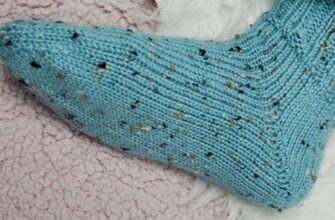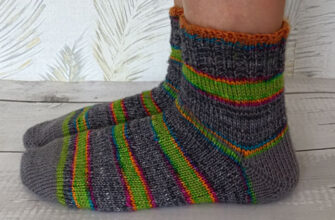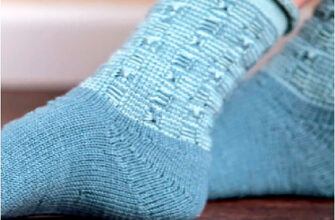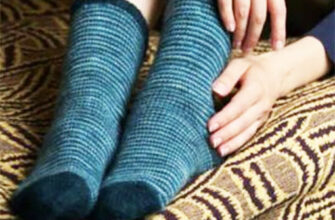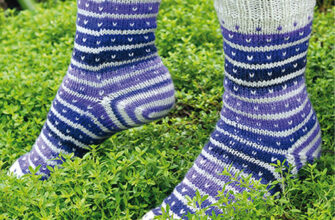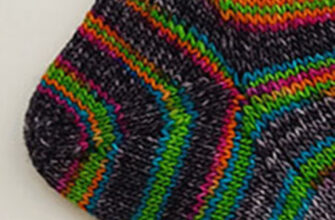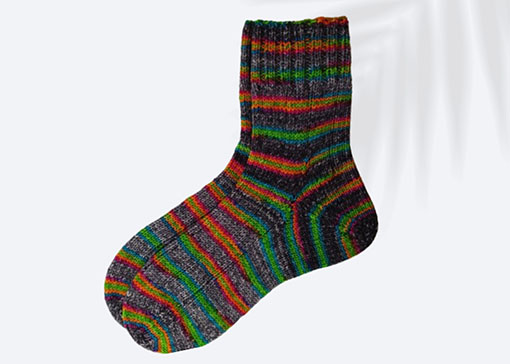
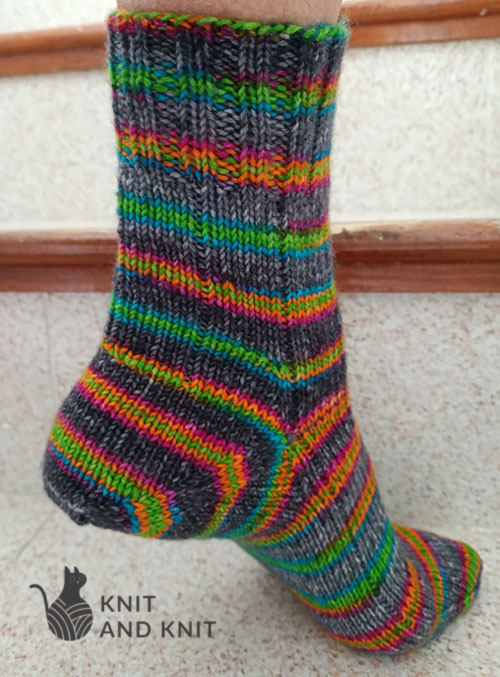
A circular heel knitted in the round looks harmonious in men’s socks made with self-striping yarn and preserves the continuity of the color pattern.
Additional comfort is provided by the gusset, which increases the depth of the foot and improves the fit.
The rounded wedge toe is shaped similarly to the heel and is finished with an invisible Kitchener stitch.
Materials, Tools, and Knitting Techniques
Sizes
40–41; 42–43; 44–45.
Materials and Tools
- Gazzal Happy Feet hand-dyed sock yarn (100 g / 330 m).
Composition: 75% merino wool, 25% polyamide. - Size 3 double-pointed needles.
- Tapestry needle.
Stitches and Techniques
- 2 × 2 ribbing (k2, p2).
- 6 × 1 ribbing (k6, p1).
- Stockinette stitch.
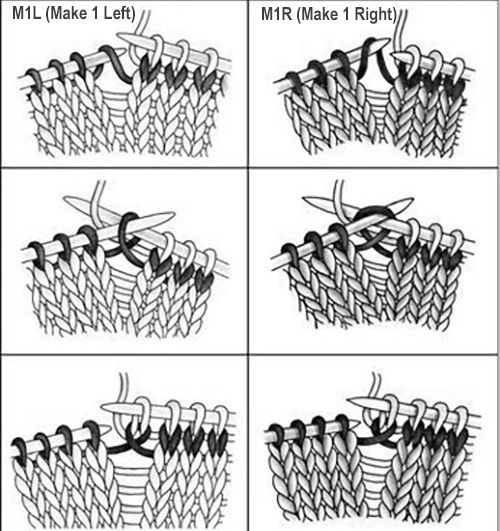
- M1L (Make 1 Left)
- M1R (Make 1 Right)
- SSK (Slip, slip, knit)
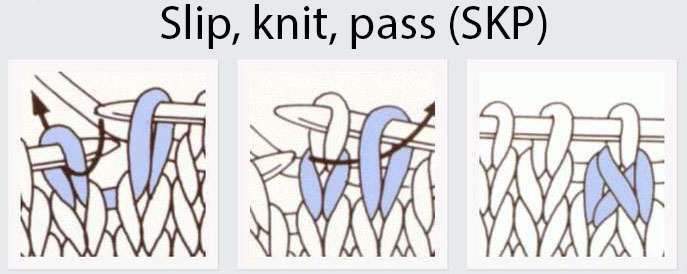
- K2tog (Knit 2 stitches together)
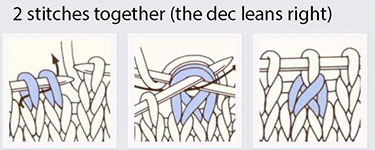
- Kitchener stitch. The technique is described in detail in the article on our website «Knit and knit»: Kitchener Stitch (Grafting) with a Needle in Stockinette Stitch.
Gauge (Needles Size 3)
23 sts × 33 rows = 10 × 10 cm.
Work Sequence
The socks are knitted in the round on five double-pointed needles. The beginning of the round is located in the center of the back of the sock. The circular heel is shaped immediately after the leg section. To increase the number of stitches for the heel, stitches are cast on using waste yarn.
For all sizes, cast on 56 stitches using the classic cast-on method with size 3 needles. Distribute the stitches across 4 needles as follows:
- Needle 1 — 13 stitches;
- Needle 2 — 15 stitches;
- Needle 3 — 14 stitches;
- Needle 4 — 14 stitches.
Ribbing and Leg
Join the cast-on edge in the round and work in 2 × 2 ribbing to a height of 6 cm.
Switch to 6 × 1 ribbing (k6, p1).
The stitches on the needles should be arranged as follows:
- Needle 1 — k6, p1, k6;
- Needle 2 — p1, k6, p1, k6, p1;
- Needle 3 — k6, p1, k6, p1;
- Needle 4 — k6, p1, k6, p1.
Work in 6 × 1 ribbing to the following heights:
- 10 cm (40–41);
- 10.5 cm (42–43);
- 11 cm (44–45).
Upper Heel Gusset
To ensure that the circular heel fits comfortably, a gusset is shaped at the instep.
To form the instep gusset, work increases at the back of the leg.
Increase 1 knit stitch from the strand between stitches leaning left, one stitch before the end of Needle 1.
Increase 1 knit stitch from the strand between stitches leaning right after the first stitch on Needle 4.
Work the increases every other round.
Number of increases on Needles 1 and 4:
- 40–41 — 3 stitches each;
- 42–43 — 4 stitches each;
- 44–45 — 5 stitches each.
Stitch Count After Increases
Size 40–41: Needle 1 — 16 stitches; Needle 2 — 15 stitches; Needle 3 — 14 stitches;Needle 4 — 17 stitches.
Size 42–43: Needle 1 — 17 stitches; Needle 2 — 15 stitches; Needle 3 — 14 stitches; Needle 4 — 18 stitches.
Size 44–45: Needle 1 — 18 stitches; Needle 2 — 15 stitches; Needle 3 — 14 stitches; Needle 4 — 19 stitches.
Heel Shaping
The circular heel is worked in knit stitches. The stitches from the front part of the leg are placed on a holder or a large safety pin, as they are not involved in shaping the heel.
Using the freed Needles 2 and 3, cast on additional stitches with waste yarn:
Size 40–41:
- Needle 2 — 17 stitches;
- Needle 3 — 16 stitches.
Size 42–43:
- Needle 2 — 18 stitches;
- Needle 3 — 17 stitches.
Size 44–45:
- Needle 2 — 19 stitches;
- Needle 3 — 18 stitches.
After casting on the additional stitches, which replace the stitches from the upper part of the leg, work the heel in the round with the main yarn.
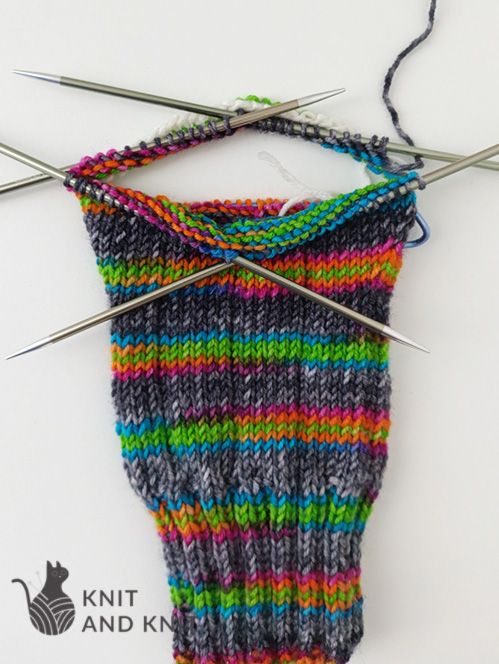
Round 1: Knit across Needle 1. Knit the stitches cast on with waste yarn on Needles 2 and 3. Finish the round by knitting across Needle 4.
Rounds 2–4: Knit all stitches.
Round 5 (Decrease Round):
- Needle 1: Knit to the last 3 stitches, k2tog, k1.
- Needle 2: K1, ssk, knit to the end of the needle.
- Needle 3: Knit to the last 3 stitches, k2tog, k1.
- Needle 4: K1, ssk, knit to the end of the needle.
Round 6: Knit all stitches.
Repeat Rows 5 and 6 until the following number of stitches remains on the needles:
- 22 stitches (40–41);
- 22 stitches (42–43);
- 18 stitches (44–45).
Distribute the stitches of the lower and upper parts of the heel evenly onto two needles:
- 11, 11, and 9 stitches on each needle respectively.
Join the remaining stitches using a tapestry needle and the Kitchener stitch.
The circular heel is now complete.
Lower Heel Gusset and Foot
Remove the waste yarn and place the released stitches onto Needles 1 and 4 for the sole of the foot.
Transfer the stitches for the top of the foot from the holder onto Needles 2 and 3.
Continue working in the round as follows:
- work the stitches on the top of the foot in pattern;
- knit all stitches on the sole of the foot.
Beginning with Round 2, work gusset decreases every other round: decrease 3, 4, or 5 stitches on each sole needle, depending on the size.
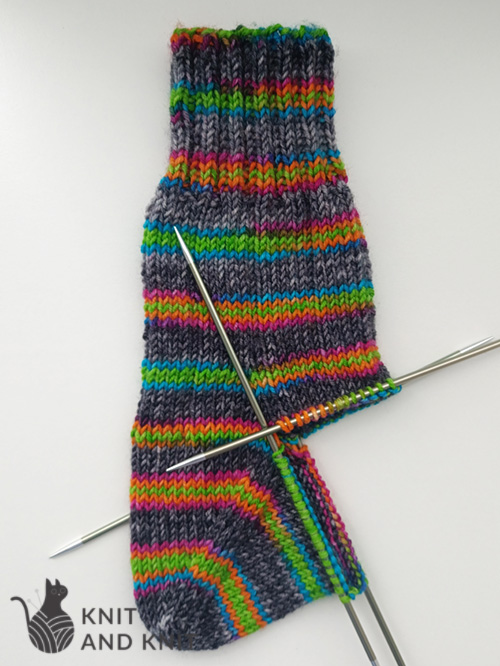
Decrease Round
- Needle 1: Knit to the last 3 stitches, k2tog, k1.
- Needles 2 and 3: Work in pattern with no decreases.
- Needle 4: K1, ssk, knit to the end of the needle.
After completing all decreases, continue working in pattern until the foot measures:
- 21.5 cm (40–41);
- 23 cm (42–43);
- 24 cm (44–45).
Measure the foot length from the back of the heel to the tip of the needles.
Toe
Work all toe decreases in stockinette stitch.
Round 1
Work decreases across the top of the foot. After completing this round, there should be 27 stitches on both the top and sole sections of the sock.
- Needle 1: Knit all stitches.
- Needle 2: K1, ssk, knit to the end of the needle.
- Needle 3: Knit to the last 3 stitches, k2tog, k1.
- Needle 4: K1, knit to the end of the needle.
Rounds 2–4: Knit all stitches.
Round 5 (Decrease Round)
- Needle 1: Knit to the last 3 stitches, k2tog, k1.
- Needle 2: K1, ssk, knit to the end of the needle.
- Needle 3: Knit to the last 3 stitches, k2tog, k1.
- Needle 4: K1, ssk, knit to the end of the needle.
Rounds 6–7: Knit all stitches.
Continue decreasing as established in Round 5:
- every 3rd round — 2 times;
- every other round — 3 times;
- then every round until 5 stitches remain on both the top and sole sections of the sock.
Join the remaining stitches using Kitchener stitch. Weave in and trim all yarn ends. Block lightly if desired.
Care Instructions
Important: Hand-dyed yarn should be washed by hand in cold water using a gentle detergent. Machine washing may cause the dye to fade, making the socks appear dull and less vibrant over time.

Conclusion
This article explains how to knit socks using self-striping yarn. A circular heel beautifully highlights the color pattern of the yarn and preserves the continuity of the stripes. If the heel eventually wears out, it can easily be unraveled and reknitted using leftover yarn. I hope this detailed tutorial helps you knit comfortable and durable men’s socks using the circular heel technique.
Read more articles on our website “Knit and Knit”:
- Cozy Men’s Socks with a Peasant Heel in 1 Evening.
- Women’s Lace Socks with a Replaceable Heel.
- Socks with a Separately Knitted Heel and an Elegant Zigzag Pattern.
- Patchwork-Style Socks with a Propeller Heel Knitted with Needles.
- How to Knit Toe-Up Socks from Self-Striping Yarn with an Additional Cast-On for the Heel.
- Socks with an Afterthought Heel and Star Decreases.
- Beautiful Men’s socks with a boomerang heel and toe.