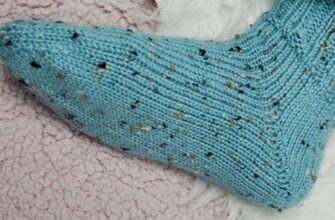
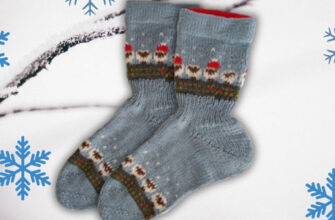
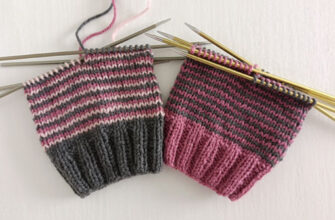
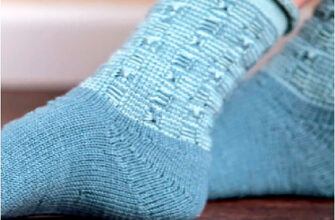
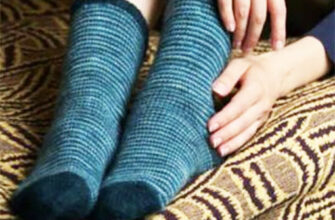
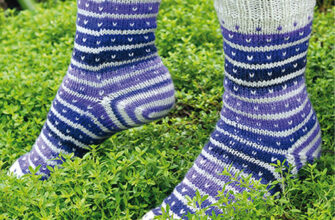
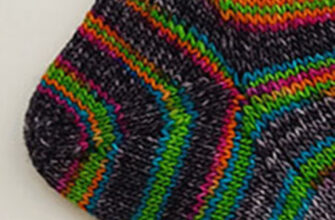
Striped socks from leftover yarn are a great way to create unique and colorful combinations.This project uses four yarn shades of different thicknesses. The self-striping yarn helps create smoother, less noticeable transitions between the stripes.
These striped socks are best worked from the toe up. This construction makes it easy to use every bit of available yarn and allows you to adjust the leg length according to the amount of yarn remaining.
Materials, Tools, and Techniques
Size
EU 36–37
Yarn
Durable Soqs (50 g / 210 m) — 21 g
75% natural wool, 25% polyamide; color: gray.
Gazzal Happy Feet (hand-dyed yarn, 100 g / 330 m) — 28 g
75% merino wool, 25% polyamide; color 3243.
Drops Fabel (50 g / 205 m) — 11 g
75% wool, 25% polyamide.
Colors used:
- 110 — 2 g
- 112 Apple Green — 7 g
Total yarn used: 62 g.
The finished pair required 56 g of yarn, leaving approximately 3 g each of the gray and Apple Green yarns.
Tools
- US 1½ (2.5 mm) double-pointed needles
- US 1½ (2.5 mm) circular needles
- Stitch holder
- Stitch markers
- Tapestry needle
Stitch Patterns and Techniques
- Stockinette stitch
- Helix knitting method (see article: Helical Knitting).
- Judy’s Magic Cast-On (see article: 5 Easy Ways to Cast On for Toe-Up Knitting).
- Short rows.
- Kitchener stitch / grafting (see article: Kitchener Stitch (Grafting) with a Needle in Stockinette Stitch).
- Stretchy bind-off.
Gauge
30 sts × 42 rnds = 4 × 4 in (10 × 10 cm)
How to Knit Striped Socks from Leftover Yarn
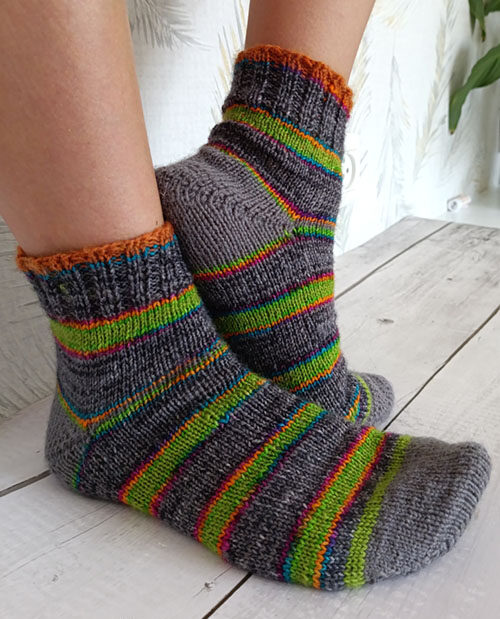
Striped socks from leftover yarn are a great way to create unique and colorful combinations.
The following yarn characteristics were taken into account during the project:
- The hand-dyed self-striping yarn has a different thickness.
- Durable Soqs yarn does not provide enough elasticity for ribbing on its own.
To compensate for the differences in yarn properties, I worked narrow three-row stripes in Drops Fabel Apple Green between the green sections of Gazzal Happy Feet. The gray sections of the self-striping yarn were combined with gray Durable Soqs yarn using the Helix knitting method.
The boomerang toe and boomerang heel were worked entirely in Durable Soqs yarn.
Toe
Upper Toe Section
The boomerang toe is worked with short rows. The turns are formed using an additional stitch worked from the stitch one row below.
Using gray Durable Soqs yarn, cast on 56 stitches with Judy Becker’s Cast-On, placing 28 stitches on each needle. Use one double-pointed needle and one circular needle for the cast-on. The circular needle should be positioned above the double-pointed needle during casting on. After casting on, slide the stitches to the center of the cable.
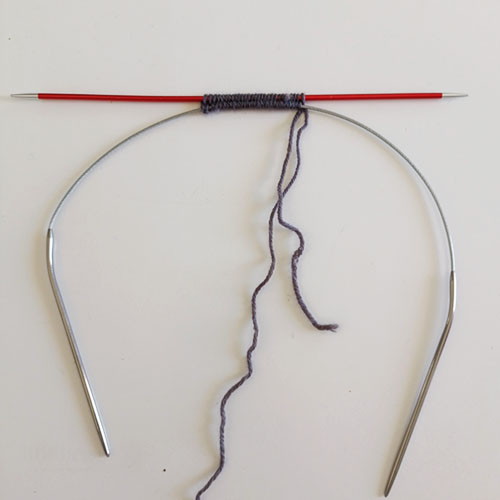
On the double-pointed needle, divide the stitches into three sections: 9 / 10 / 9 stitches. Place markers between the sections.
Row 1 (RS): Knit 27 sts. Knit the next stitch. Return the newly formed stitch to the left needle through the same leg from which it was worked. This creates the first double stitch. Without removing the worked stitch from the left needle, turn the work.
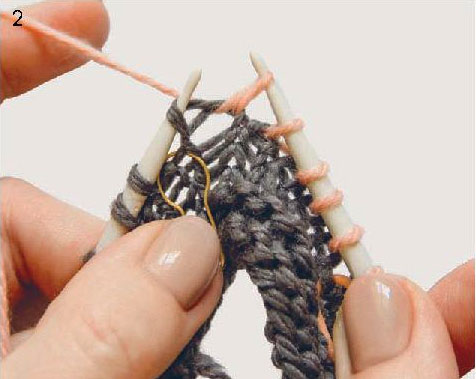
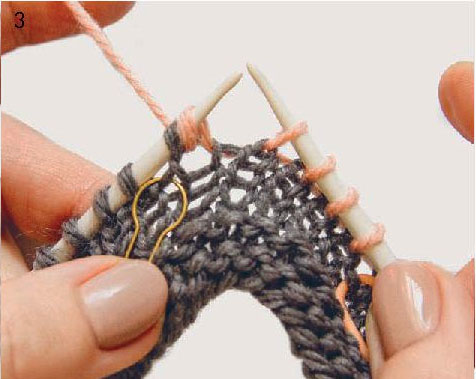
Row 2 (WS): Purl 26 sts. Purl the next stitch. Return the newly formed stitch to the left needle through the same leg from which it was worked. This creates another double stitch. Without removing the worked stitch from the left needle, turn the work.
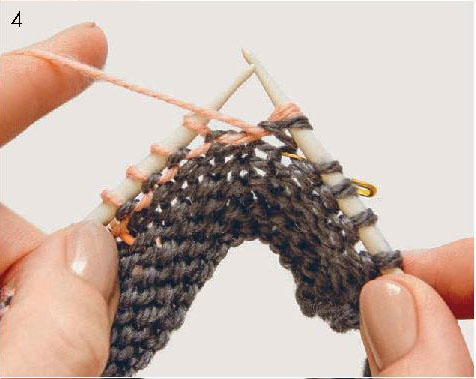
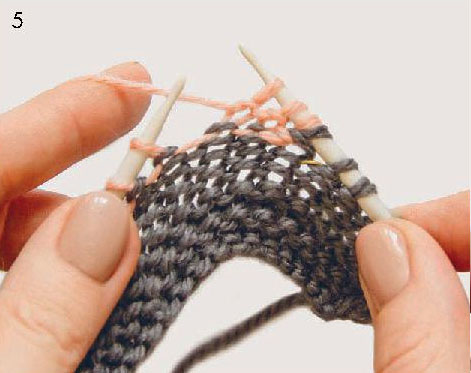
Row 3: Knit 25 sts. Insert the right needle into the stitch one row below the next stitch and knit it. Turn the work without removing the resulting double stitch from the left needle. There are now two double stitches on the working needle.
Row 4: Purl 24 sts. Insert the right needle into the stitch one row below the next stitch and purl it. Turn the work without removing the resulting double stitch from the left needle. There are now two double stitches on the working needle.
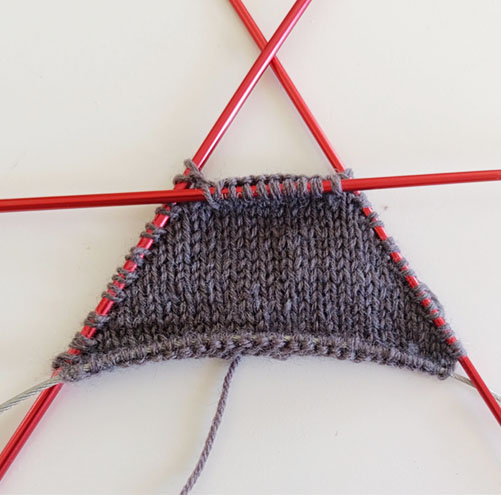
Repeat Rows 3 and 4 until all stitches in the right and left side sections of the toe have been converted into double stitches.
Transition Rows
Knit the first double stitch together through the back loops. Work all remaining double stitches of this side section in the same manner.
Knit across the stitches of the center section.
Then work all double stitches of the second side section in the same way, knitting them together through the back loops.
Turn the work and purl one complete row.
Lower Toe Section
Row 1: Knit across. When you reach the first side section of the toe, insert the right needle into the stitch one row below the first stitch of the side section and knit it. Return the newly formed stitch to the left needle through the same leg from which it was worked.
Turn the work without removing the resulting double stitch from the left needle. The double stitch is now on the working needle.
Row 2: Purl across. When you reach the second side section of the toe, insert the right needle into the stitch one row below the first stitch of the side section and purl it. Return the newly formed stitch to the left needle through the same leg from which it was worked.
Turn the work without removing the resulting double stitch from the left needle. The double stitch is now on the working needle.
Row 3: Knit to the double stitch. Knit the double stitch together through the back loops. Then insert the right needle into the next stitch one row below and knit it.
Turn the work without removing the resulting double stitch from the left needle.
Row 4: Purl to the double stitch. Purl the double stitch together. Then insert the right needle into the next stitch one row below and purl it.
Turn the work without removing the resulting double stitch from the left needle.
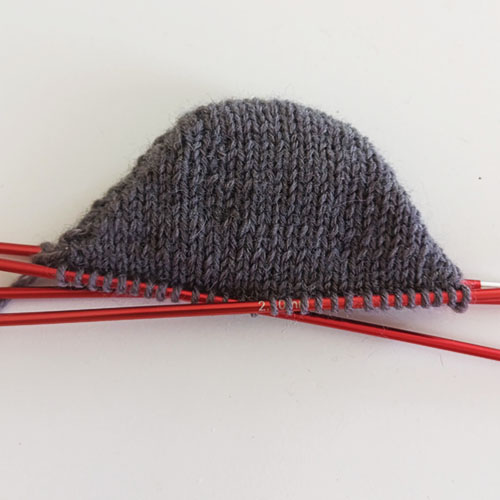
Repeat Rows 3 and 4 until all stitches of the right and left side sections have been incorporated into the work. The toe is now complete.
Foot
Redistribute the toe stitches and the cast-on stitches held on the circular needle onto four double-pointed needles, with 14 stitches on each needle.
Knit 2 rounds in stockinette stitch without changing yarn.
Change to the Apple Green yarn and knit 3 rounds.
Continue working with the hand-dyed yarn until you reach the beginning of the green section. Knit 1 round in the green color. Change to the Apple Green yarn and knit 3 rounds.
Next, continue with the hand-dyed yarn until you reach the gray section. Work the gray section using the Helix method, alternating it with gray Durable Soqs yarn.
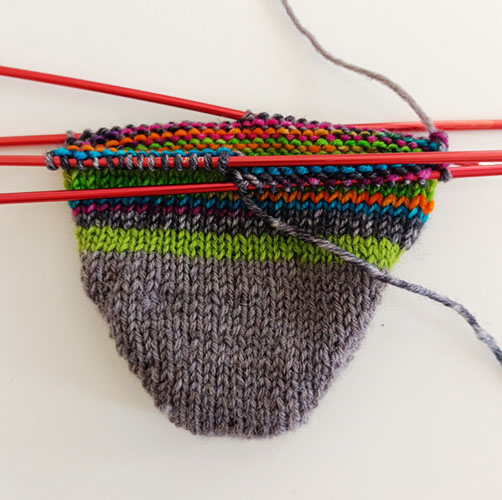
Work the stitches of the gray section across three needles. Leave the stitches on the fourth needle unworked.
Join the gray Durable Soqs yarn at the beginning of the needle where the gray section started.
Knit across two needles. Then return to the hand-dyed yarn and knit across the next two needles.
Repeat from * until the entire gray section has been worked.
Continue with the hand-dyed yarn until you reach the next green section. Knit 1 round in the green color.
Change to the Apple Green yarn and knit 3 rounds.
Continue in this manner until the foot measures 19 cm (7½”) in length.
For symmetry, you may finish after completing a green section.
Heel
These striped socks are worked with a boomerang heel. The heel is shaped with short rows, with each turn formed by creating an additional stitch from the stitch one row below. Use gray Durable Soqs yarn for the heel.
To increase the heel width, redistribute two edge stitches from each instep needle to the heel. The heel will now consist of 32 stitches.
Lower Heel Section
Divide the heel stitches into three sections: 11 / 10 / 11 stitches. Place markers between the sections.
Begin working at the center of the heel.
Row 1: Knit 15 sts. Insert the right needle into the stitch one row below the next stitch and knit it. Return the newly formed stitch to the left needle through the same leg from which it was worked. This creates the first double stitch. Turn the work without removing the worked stitch from the left needle.
Row 2: Purl 30 sts. Insert the right needle into the stitch one row below the next stitch and purl it. Return the newly formed stitch to the left needle through the same leg from which it was worked. This creates another double stitch. Turn the work without removing the worked stitch from the left needle.
Row 3: Knit 28 sts. Insert the right needle into the stitch one row below the next stitch and knit it. Turn the work without removing the resulting double stitch from the left needle. There are now two double stitches on the working needle.
Row 4: Purl 27 sts. Insert the right needle into the stitch one row below the next stitch and purl it. Turn the work without removing the resulting double stitch from the left needle. There are now two double stitches on the working needle.
Repeat Rows 3 and 4 until all stitches in the right and left side sections of the heel have become double stitches.
Transition Rounds
Begin at the center of the heel.
Round 1: Knit 5 sts. Knit the first double stitch together through the back loop. Work all remaining double stitches of this side section in the same manner.
Knit across the instep stitches.
Then work all double stitches of the second side section in the same way, knitting them together through the back loops. Finish with 5 knit stitches.
Round 2: Knit all stitches, including the instep stitches.
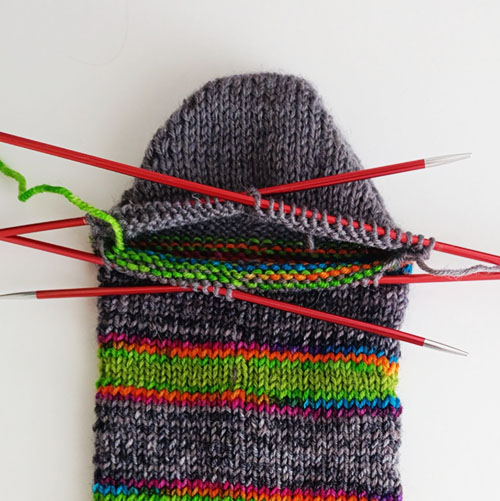
Upper Heel Section
Row 1: Knit across. When you reach the first side section of the heel, insert the right needle into the stitch one row below the first stitch of the side section and knit it. Return the newly formed stitch to the left needle through the same leg from which it was worked.
Turn the work without removing the resulting double stitch from the left needle. The double stitch is now on the working needle.
Row 2: Purl across. When you reach the second side section of the heel, insert the right needle into the stitch one row below the first stitch of the side section and purl it. Return the newly formed stitch to the left needle through the same leg from which it was worked.
Turn the work without removing the resulting double stitch from the left needle. The double stitch is now on the working needle.
Row 3: Knit to the double stitch. Knit the double stitch together through the back loops. Then insert the right needle into the next stitch one row below and knit it.
Turn the work without removing the resulting double stitch from the left needle.
Row 4: Purl to the double stitch. Purl the double stitch together. Then insert the right needle into the next stitch one row below and purl it.
Turn the work without removing the resulting double stitch from the left needle.
Repeat Rows 3 and 4 until all stitches in the right and left side sections of the heel have been incorporated into the work.
Leg
Redistribute 2 heel stitches back to each instep needle. There should now be 14 stitches on each needle.
Work with the hand-dyed yarn until you reach the gray section. Join the gray Durable Soqs yarn and continue using the Helix method until the next colored section begins. Work the colored section in the same manner as on the foot.
Ribbing
Work a K2, P2 rib using the Helix method. Finish the ribbing with three rounds of rust-colored yarn.
Bind off loosely using a stretchy bind-off method.
Work the second sock in the same way and wet-block the finished pair.
Conclusion
This article explains how to knit striped socks from leftover yarn. Four shades of yarn with different thicknesses were used in the project. The socks are worked from the toe up, making it possible to use leftover yarn efficiently and adjust the leg length according to the amount of yarn available.
Read our other articles: