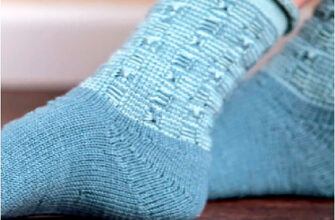
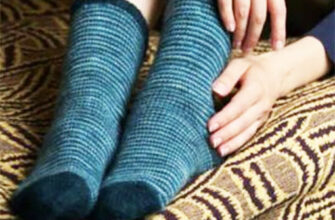
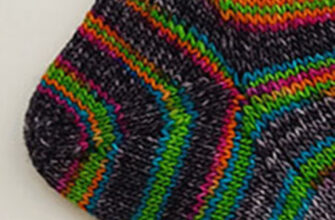
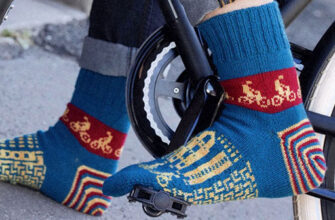
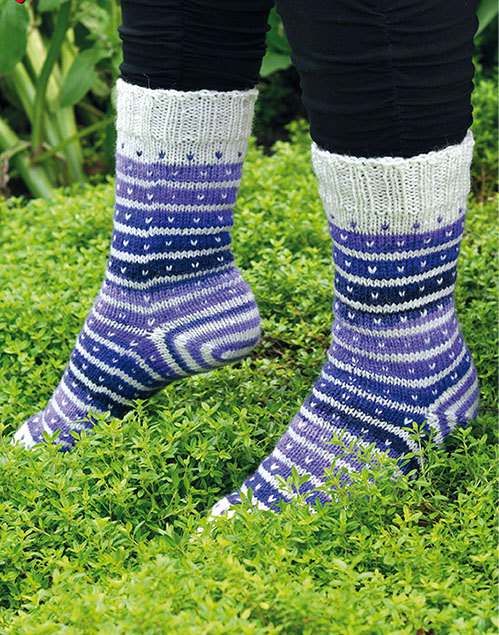
These toe-up socks with an afterthought heel feature a simple colorwork pattern worked in a soft lavender palette. The harmonious combination of gentle shades and a neat motif makes this design cozy, stylish, and versatile. Thanks to the afterthought heel construction, the socks fit comfortably and the heel can be easily replaced when worn, extending the life of the garment.
Design: Linda Hayden
Photos: Maya Karlsson
- Materials, Tools, and Techniques
- Sizes
- Yarn
- Needles and Notions
- Knitting pattern
- Gauge
- Notes
- Afterthought Heel
- Stretchy Bind-Off
- Toe-Up Socks with an Afterthought Heel
- Cast-On
- Toe
- Foot
- Heel Opening
- Leg
- Heel
- Upper Part of the Heel
- Finishing Toe-Up Socks with an Afterthought Heel
- How to Block and Wash Toe-Up Socks with an Afterthought Heel
- Conclusion
Materials, Tools, and Techniques
Sizes
23–24 (25–26) 27–28 (29–30) 31–32 (33–34) 35–36 (37–38) 39–40 (41–42) 43–44
Yarn
Mellanraggi (75% superwash wool, 25% polyamide; approximately 260 m / 100 g)
Color 1: approximately 30 (30) 30 (30) 40 (40) 50 (50) 60 (60) 70 g (28201)
Color 2: approximately 25 (25) 25 (25) 35 (35) 45 (45) 55 (55) 65 g (28354)
Needles and Notions
- 3 mm double-pointed needles (DPNs), or
- 3 mm circular needles with an 80 cm cable for the Magic Loop method
Knitting pattern
Gauge
25 sts × 33 rows = 10 × 10 cm (4 × 4 in) in Stockinette Stitch worked on 3 mm needles.
Notes
Here you will find detailed instructions to help you knit these toe-up socks with an afterthought heel.
Afterthought Heel
The heel is worked after the main part of the sock has been completed. The sock is initially knitted without a heel; a waste-yarn marker is worked across the stitches where the heel will later be placed. The heel stitches are then picked up from this opening and worked in the round, shaped with decreases (similar to the toe). This method can also be used for top-down socks.
Stockinette Stitch in the Round: Knit every round.
Invisible Cast-On: Judy’s Magic Cast On
The cast-on is worked over two needles (either double-pointed needles or circular needles for the Magic Loop method). If using double-pointed needles, it is recommended to distribute the stitches evenly across four needles on the second round.
When Working with Double-Pointed Needles:
- Needles 1 and 2: instep (top of foot)
- Needles 3 and 4: sole
When Working with the Magic Loop Method:
- Needle 1: instep (top of foot)
- Needle 2: sole
Increase 1 Stitch (KFB): Knit into the front loop and then into the back loop of the same stitch.
Left-Leaning Decrease (Slip, Slip, Knit): Slip 1 stitch knitwise, knit 1 stitch, then pass the slipped stitch over the knitted stitch.
Stretchy Bind-Off
Knit 2 stitches. Return both stitches to the left-hand needle and knit them together through the back loops.
[Work 1 purl stitch (= 2 stitches on the right-hand needle), return both stitches to the left-hand needle, keeping the yarn in front of the work, and purl them together. Repeat from * to * once more.
Work 1 knit stitch (= 2 stitches on the right-hand needle), return both stitches to the left-hand needle, keeping the yarn at the back of the work, and knit them together through the back loops. Repeat from * to * once more.]
Continue in this manner until only 1 stitch remains.
Note: In English knitting patterns, the decrease you describe is traditionally abbreviated as SKP (Slip 1, Knit 1, Pass Slipped Stitch Over) rather than SSK, because the slipped stitch is passed over the knitted stitch. If this translation is intended for publication, I would recommend naming it SKP (left-leaning decrease) to match standard English knitting terminology.
Toe-Up Socks with an Afterthought Heel
Cast-On
Using your preferred invisible cast-on method and Color 1, cast on with 3 mm circular needles: 14 (18) 18 (18) 18 (22) 22 (26) 26 (26) 30 sts,
divided as follows: 7 (9) 9 (9) 9 (11) 11 (13) 13 (13) 15 sts on each needle.
Toe
Round 1:
Instep: K1, KFB, knit to last 2 sts, KFB, K1.
Sole: Repeat from * to *.
Round 2: Knit all stitches.
Repeat Rounds 1 and 2 until you have a total of 36 (40) 40 (44) 44 (48) 48 (52) 56 (56) 60 sts.
Foot
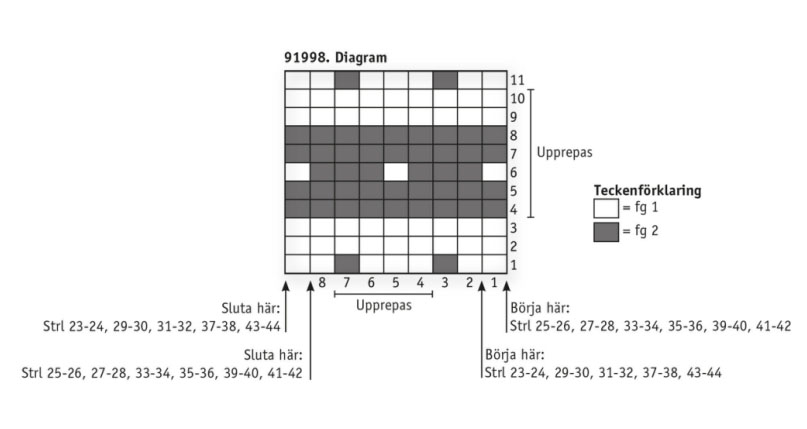
Work in Stockinette Stitch and follow the chart pattern.
When the foot measures approximately 9½ (10½) 11½ (12½) 13½ (15½) 16½ (17½) 18½ (20) 20½ cm,
place the marker for the heel opening. Adjust your knitting so that the last completed round is either Round 9 or Round 5 of the chart.
Heel Opening
Next Round:
Instep:
Work in pattern according to the chart. If you are on Round 6 of the chart, work the pattern with Color 1 and then break the yarn, as the chart pattern is worked over only half of the round.
Sole:
Using waste yarn in a contrasting color, knit all 18 (20) 20 (22) 22 (24) 24 (26) 28 (28) 30 sts.
Use a double-pointed needle, or alternatively slip the worked stitches back onto the left-hand needle. Then rejoin the working yarn and knit across the waste-yarn stitches once more.
Tip:
Work the stitches immediately before and after the waste-yarn section firmly to prevent holes from forming later when the heel is worked.
Leg
Continue working in Stockinette Stitch and following the chart pattern until the leg contains the same number of stripes as the foot.
Finish with Round 10 of the chart and work Round 11, then break yarn Color 2.
Continue in Stockinette Stitch with Color 1 for 3 (3) 3 (3) 4 (4) 4 (4) 4 (4) 4 rounds, then work in ribbing (K2, P2) for approximately 3 (3) 3 (3) 4 (4) 4 (4) 5 (5) 5 cm.
Bind off using a stretchy bind-off method.
Break yarn and secure ends.
Heel
Carefully remove the waste yarn while transferring the live stitches onto two needles.
You should have:
18 (20) 20 (22) 22 (24) 24 (26) 28 (28) 30 sts for the lower part of the heel (towards the toe) and
17 (19) 19 (21) 21 (23) 23 (25) 27 (27) 29 sts for the upper part of the heel (towards the leg).
The heel is worked in stripes of 3 rounds per color. Begin with the same color you were working before the heel marker section.
It does not matter which needle you start with, but pick up stitches as follows:
Round 1
Lower heel: Pick up and knit 1 stitch from the stitch before the live stitches of this row, then knit across all stitches, and pick up and knit 1 stitch from the stitch after the end of the live stitches.
Tip: Keep the yarn sufficiently taut at the edges to avoid gaps.
Upper Part of the Heel
Pick up 2 knit stitches before the live stitches
(1 stitch from the row above + 1 stitch from the same row), then knit across all stitches, and pick up 1 knit stitch from the next stitch of the same row. = 5 increases completed
Total: 40 (44) 44 (48) 48 (52) 52 (56) 60 (60) 64 sts.
Round 2:
Lower Heel: Work a left-leaning decrease (SKP), knit to the last 2 stitches, k2tog.
Upper Heel: Repeat from * to * = 4 stitches decreased
Total: 36 (40) 40 (44) 44 (48) 48 (52) 56 (56) 60 sts.
Continue working in Stockinette Stitch and stripes for another 0 (1) 1 (2) 2 (2) 4 (5) 4 (4) 5 rounds without decreases.
Next Round (Decrease Round)
Lower Heel: * Work SKP, knit to the last 2 stitches, k2tog.
Upper Heel: Repeat from * to *.
Next Round: Knit all stitches in the round.
Repeat the last 2 rounds until only 8 (10) 12 (12) 12 (16) 28 (16) 20 (20) sts remain (the last round should be a decrease round).
Break yarn, leaving a long tail for grafting the remaining stitches together.
Finishing Toe-Up Socks with an Afterthought Heel
Graft the heel stitches using the Kitchener stitch (grafting). The edge stitches on each side are grafted simultaneously, as if they had previously been knit together. Secure all yarn ends.
How to Block and Wash Toe-Up Socks with an Afterthought Heel
Yarn may bleed when exposed to prolonged moisture. Take extra care when blocking and washing items with contrasting colors. Lightly dampen the finished socks, preferably using a spray bottle. Gently remove excess moisture by rolling the item in a towel. Dry flat, shaping the socks to the correct measurements.
Conclusion
This article explains how to knit toe-up socks with an afterthought heel. To make the process easier, detailed instructions have been provided, along with explanations of techniques and key knitting methods.
Step-by-step guidance helps you understand how to shape the toe, work the afterthought heel, and neatly finish the stitches. This design is suitable both for everyday wear and as a cozy handmade gift. The simple pattern and comfortable construction make these socks both practical and visually appealing.
Read our other materials:
- Men’s Sport Socks “Cyclist” with a Replaceable Heel
- 10 Popular Ways to Knit Socks with an Afterthought Heel
- Circular Heel in Men’s Socks Made with Self-Striping Yarn
- Socks with a Separately Knitted Heel and an Elegant Zigzag Pattern
- How to Knit Toe-Up Socks from Self-Striping Yarn with an Additional Cast-On for the Heel
- Beautiful Striped Knitted Socks with an Afterthought Heel