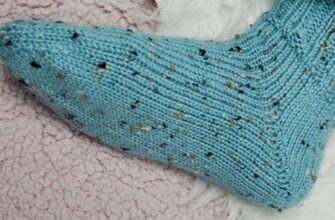
Cozy Men’s Socks with a Peasant Heel You Can Knit in One Evening. Socks knitted according to simple and easy-to-follow instructions. First, the sock is worked without the heel. The stitches in the area where the heel should be are knitted using waste yarn.
The heel is knitted last in circular rounds. This method is perfect for those who do not like working short rows. The heel can easily be unraveled and reknitted if it becomes worn out.
Materials, Tools, and Knitting Techniques
Size
- 40–41 (EU) — 7–7.5 (US) — 6.5–7 (UK).
- 42–43 (EU) — 8.5–9.5 (US) — 8–9 (UK).
- 44–45 (EU) — 10.5–11.5 (US) — 10–11 (UK).
Tools and Materials
- 100 g of Regia Pairfect yarn by Schachenmayr
Yarn specifications: 420 m / 100 g
Composition: 75% wool, 25% polyamide. - Double-pointed needles and circular needles with a cable length of 80–100 cm, size 2.5 mm.
- Tapestry needle with a large eye.
- Stitch holder or safety pin for holding stitches.
- Stitch markers.
- Scissors.
Stitches and Techniques
- Stockinette Stitch: Knit all rounds.
- Ssk (Slip, slip, knit): Knit Two Together Leaning Left.
- Ssp (Slip, slip, purl): Knit Two Together Leaning Right.
- Magic Loop: Knitting Two at a Time.
- 4-Stitch Cable (Left Twist)
Number of stitches must be divisible by 6.
Row 1: Purl 2, knit 4. Repeat from * to the end of the row.
Rows 2, 3, 4, and 6: Work all stitches as they appear.
Row 5: Purl 2, work a 4-stitch left cable (slip 2 stitches onto a cable needle and hold in front of the work, knit 2, then knit the 2 stitches from the cable needle). Repeat from * to the end of the row.
Gauge
- Stockinette stitch: 36 stitches = 10 cm.
- Cable pattern: 34 stitches = 10 cm.
How to Knit Men’s socks with a Peasant heel
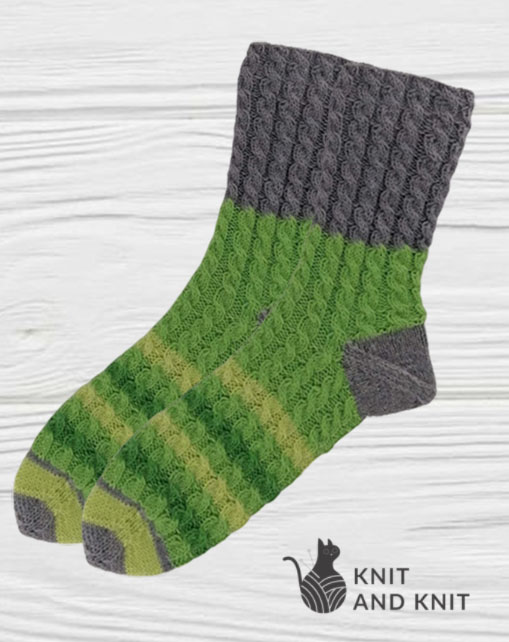
The socks with a peasant heel are knitted on circular needles with an 80–100 cm cable using the magic loop method.
To save time, it is best to knit both socks simultaneously. Each sock is worked from a separate ball of yarn, so the yarn should be divided before starting.
I do not recommend pulling the yarn for the second sock from the center of the ball, as this may cause tangling, inconvenience, and slower progress.
Any cast-on method may be used. For simplicity, we will use the classic cast-on method, which creates a sufficiently elastic edge and is ideal for socks.
Leg
Cast on 66 (72, 78) stitches for each sock. After casting on, begin working the leg. Each sock is knitted strictly from its own ball of yarn.
Distribute the stitches as follows:
- Size 40–41: sole — 36 sts, top of foot — 30 sts.
- Size 42–43: sole — 42 sts, top of foot — 30 sts.
- Size 44–45: sole — 42 sts, top of foot — 36 sts.
First knit the sole stitches of the first sock. Then move to the second sock. After the sole stitches have been worked, turn the work.
On the next needle, first knit the stitches of the second sock and then the stitches of the first sock.
Work 72 (78, 84) rows in the cable pattern.
Next, knit the sole stitches using waste yarn in a contrasting color. The heel will later be formed in this section. Slide the stitches back to the beginning of the row and knit the stitches previously worked with the waste yarn using the main yarn.
Foot
Work 60 (66, 72) rows from the waste yarn section in the cable pattern.
Toe Shaping
To shape the toe, transfer the first and last 3 (6, 3) sole stitches onto the needle holding the top-of-foot stitches.
The toe is worked in stockinette stitch. Decreases are worked every other row. The stitches on the top and bottom of the sock are decreased evenly.
Row 1: Knit all stitches.
Row 2: K1, SSK (Slip, slip, knit), knit 27 (30, 33), SSP (Slip, slip, purl), k1.
Decrease the stitches on the second needle in the same way.
Rows 3 and 5: Work without decreases.
Row 4: K1, SSK (Slip, slip, knit), knit 25 (28, 31), SSP (Slip, slip, purl), k1.
Ssk (Slip, slip, knit): Knit Two Together Leaning Left
Ssp (Slip, slip, purl): Knit Two Together Leaning Right
Row 1: Knit all stitches.
Row 2: K1, knit 2 together leaning left, knit 27 (30, 33), knit 2 together leaning right, k1.
Decrease the stitches on the second needle in the same way.
Rows 3 and 5: Work without decreases.
Row 4: K1, knit 2 together leaning left, knit 25 (28, 31), knit 2 together leaning right, k1.
Beginning with Row 7, work decreases in every row.
When 4 stitches remain on each needle, close the stitches using a large needle and secure the yarn ends firmly.
Replaceable Sock Heel
To finish knitting the socks with a peasant heel, remove the waste yarn. Place the released stitches onto two needles.
Pick up one stitch from the bars between rows onto both the first and second needles. Each needle should contain 38 (44, 44) stitches.
Rows 1–4: Knit all stitches.
Row 5 and all following odd-numbered rows: K1, SSK (Slip, slip, knit), knit 32 (38, 38), SSP (Slip, slip, purl), k1.
Decrease the stitches on the second needle in the same way.
Row 6 and all following even-numbered rows: Work without decreases.
When 4 stitches remain on each needle, gather them using a large needle.
This article describes how to knit socks with a peasant heel.
Conclusion
Men’s socks with a peasant heel are practical, comfortable, and easy to knit. The replaceable heel construction makes the socks especially durable, since the heel can be unraveled and reknitted whenever needed. This technique is ideal for knitters who prefer working in the round and want to avoid short rows. The simple construction, combined with textured cable patterns, creates warm and durable socks suitable for everyday wear.
Read our other articles about knitting socks with a peasant heel:
- Women’s Lace Socks with a Replaceable Heel.
- Socks with a Separately Knitted Heel and an Elegant Zigzag Pattern.
- Knitted socks
- Patchwork-Style Socks with a Propeller Heel Knitted with Needles.
- How to Knit Toe-Up Socks from Self-Striping Yarn with an Additional Cast-On for the Heel/
- Men’s socks with a boomerang heel and toe.