Choosing the right knitting needles for socks is essential for comfort, speed, and overall knitting experience. Whether you are a beginner or an experienced knitter, understanding different needle types, materials, and techniques will help you achieve the best results.
- Popular Knitting Needle Brands for Socks
- Knitting Needle Materials
- Types of Knitting Needles for Socks
- Most Popular Ways to Knit Socks
- Knitting Socks with Double-Pointed Needles (DPNs)
- Knitting Socks with Four Needles
- Knitting Socks with Circular Needles (Magic Loop Method)
- Two Circular knitting needles for socks
- Knitting Socks with Addi CraSy Trio
- Knitting Socks with Short “Sock Wonder” Needles
- Knitting Socks on Two Straight Needles
- Conclusion
Popular Knitting Needle Brands for Socks
When selecting sock knitting needles, many knitters focus not only on size but also on trusted brands. Among the most popular are ChiaoGoo, Addi, KnitPro, Prym, and HiyaHiya. These brands are known for high-quality materials, comfortable tips, and durability.
ChiaoGoo and HiyaHiya needles are especially popular for sock knitting due to their sharp tips, which make it easier to work with fine yarns. Addi needles are famous for their smooth finish, allowing stitches to glide effortlessly. KnitPro offers a wide range of materials — from metal to wood. Knitters can choose tools that suit their personal style.
Knitting Needle Materials
Sock knitting needles are made from a variety of materials, including:
- Stainless steel.
- Aluminum.
- Carbon fiber.
- Plastic.
- Wood or bamboo.
They can also come in round or square shapes, which can affect grip and tension.
Types of Knitting Needles for Socks
Socks can be knitted using different types of needles:
- Double-pointed needles (DPNs).
- Circular needles.
- Straight needles.
- Addi CraSy Trio.
- Short circular needles (“sock wonder” needles)
Most Popular Ways to Knit Socks
Traditional socks are usually knitted in the round. Since socks fit snugly around the foot, seams can cause discomfort and affect the appearance.
Knitting Socks with Double-Pointed Needles (DPNs)
Knitting socks with five double-pointed needles is the most common method. These needles are also called sock needles.
Stitches are cast on one needle and then evenly distributed across four needles. The fifth needle is used for knitting. As you knit, the empty needle becomes the working needle.
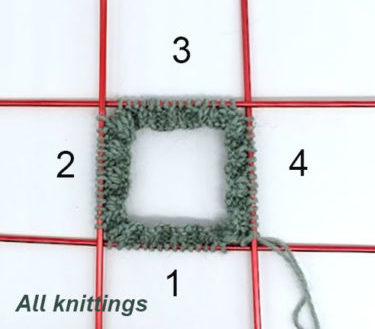
In most sock patterns, needles are numbered to indicate where specific steps begin—such as shaping the heel or toe. This is especially helpful when working with colorwork or complex stitch patterns.
You can also knit socks from the toe up using DPNs by starting with the toe instead of the cuff.
Knitting Socks with Four Needles
Socks can also be knitted with four needles. Stitches are divided across three needles. The fourth needle is used for knitting.
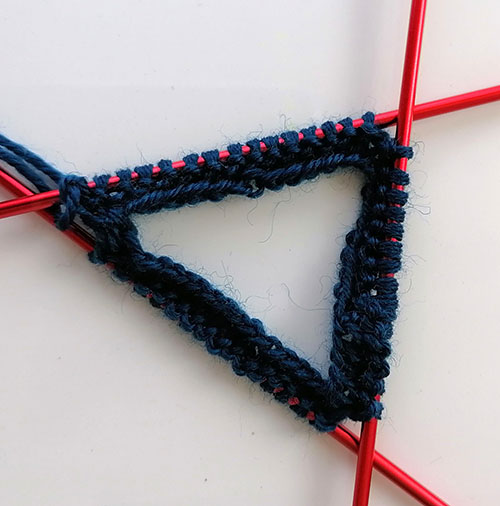
This method is less common but works similarly to the five-needle technique.
Knitting Socks with Circular Needles (Magic Loop Method)
The magic loop method is one of the easiest and fastest ways to knit socks. Ideal for knitting in the round. Allows you to knit two socks at the same time. Saves up to 50% of knitting time compared to DPNs.
Recommended cable lengths:
- ~80 cm (32 inches) for one sock.
- 100 cm+ (40 inches or more) for two socks at once
With this method, there is no need to number needles—the sock is simply divided into front and back sections. Knitting two socks at once from the toe up is especially popular among modern knitters. For colorwork (jacquard) socks, however, it is often easier to knit each sock separately.
The cast-on method for knitting socks using the Magic Loop technique is described in our article: Magic Loop: Knitting Two at a Time.
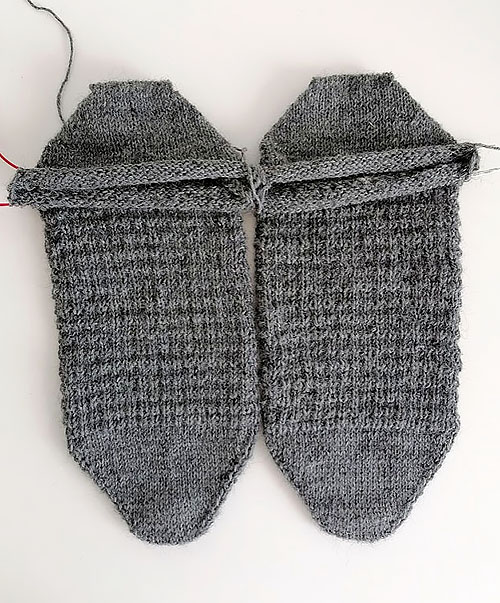
Read about toe-up knitting in our articles: 5 Easy Ways to Cast On for Toe-Up Knitting.
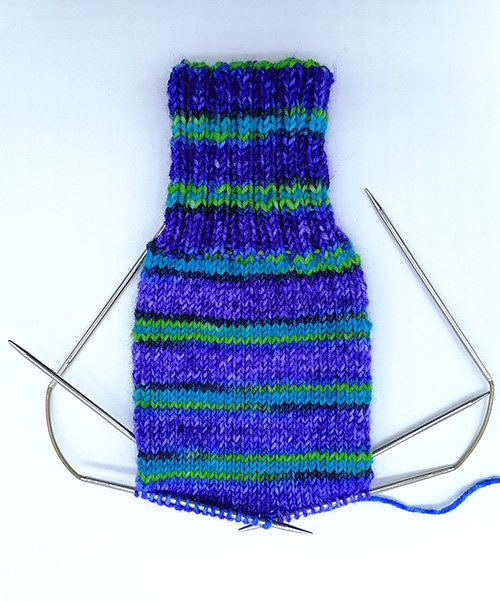
Two Circular knitting needles for socks
If you don’t have a long cable, you can use two circular needles. Stitches are divided into two equal parts. Each part is worked with its own needle. This method eliminates the need to constantly switch needles and is quite comfortable once mastered. Recommended cable length: about 60 cm (24 inches).
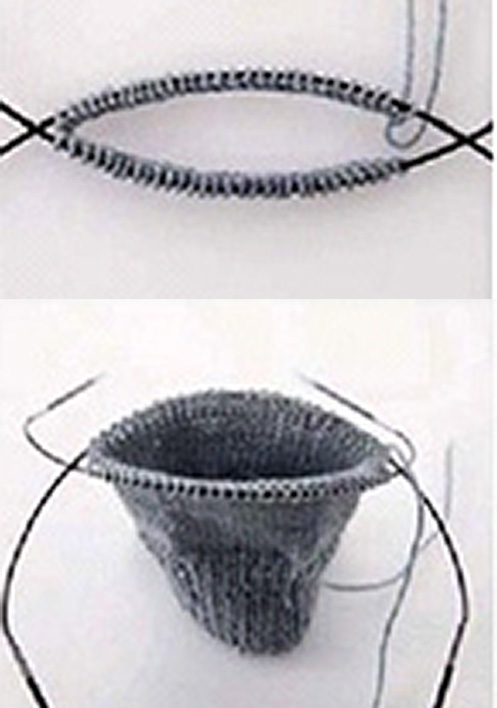
Step-by-step instructions knitting needles for socks:
- Cast on stitches onto two pairs of circular needles.
- Slide the back stitches onto the cable of the second pair so that both ends hang freely. Knit the front stitches with the working tip of the first pair using the desired pattern.
- Slide the worked stitches onto the cable of the first pair of circular needles and leave them there. Turn the work.
- Pull the left tip of the second pair so the stitches slide from the cable onto the right tip, then knit them with the working end of the second pair.
- Continue knitting in this way. The other half, already worked, will remain on the cable of the circular needle pair that is not currently in use.
Knitting Socks with Addi CraSy Trio
The CraSy Trio set consists of three flexible double-pointed needles connected by short cables.
Stitches are distributed across two needles. The third needle is used for knitting. This method is less common. Some knitters find it extremely for small-circumference knitting, while others prefer traditional methods. One drawback is the higher price compared to standard needles.
Knitting Socks with Short “Sock Wonder” Needles
Short circular needles (often called “sock wonder” needles) are designed specifically for small projects. One needle is longer (working needle), the other shorter (holding stitches).
This method is not very popular among knitters, their very short length (about 25 cm) can feel uncomfortable.
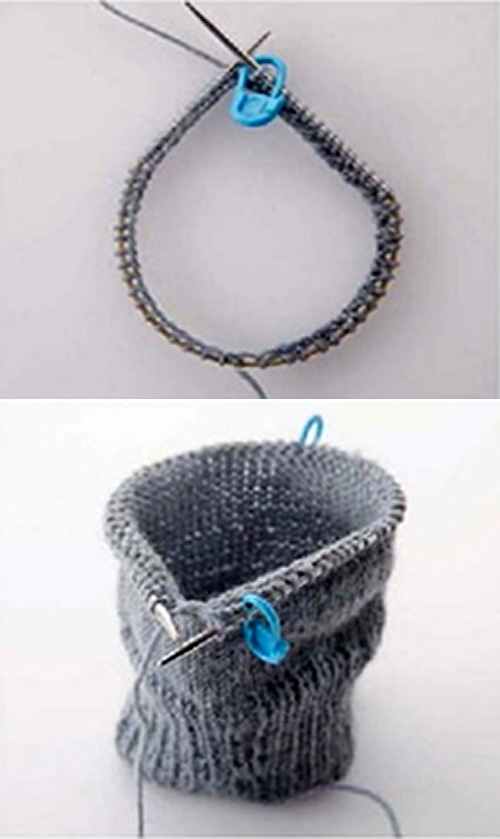
Instructions for knitting needles for socks with short circular needles:
- Cast on the required number of stitches onto the longer needle tip. Join the needles into a circle so that both tips and the beginning and end of the cast-on row meet. Make sure the cast-on edge is not twisted.
- Hold the needles so that the longer tip is in your right hand and the shorter tip is in your left. Using the working yarn, knit the first stitch from the short tip with the long tip, tightening the yarn firmly. This will join the round. The beginning of the round is automatically marked by the yarn tail.
- Knit half of the total number of stitches in the chosen cuff pattern (note: count stitches starting from the first one). Place a marker. Then knit the second half of the stitches. The first round is complete.
- Continue working in rounds in this way, always marking the halfway point with a stitch marker and knitting stitches from the short tip onto the long tip. Once the sock length increases by a few centimeters, you can place an additional marker at the beginning of the round for better orientation.
Knitting Socks on Two Straight Needles
Knitting socks on two needles differs in sequence from knitting in the round, as the work is done in flat (back-and-forth) rows rather than circular rounds.
First, the back part of the sock is knitted, followed by the front part.
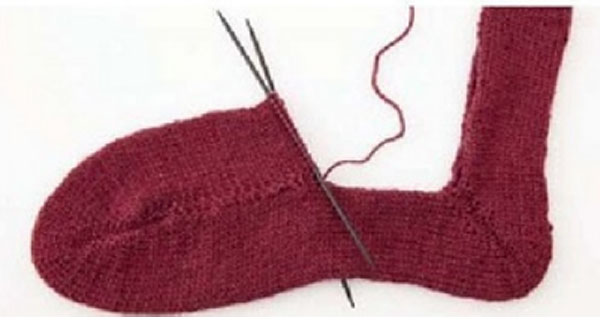
In practice, the process looks like this:
- For the back part of the sock, cast on half of the total number of stitches.
- The leg is worked first in ribbing, then in stockinette stitch.
- The first half of the heel is knitted in stockinette stitch. On right-side rows, decrease the first two and last two stitches by working them together until one-third of the original number of stitches remains on the needle.
- In the second half of the heel, stitches are increased again. At the same time, this section is joined to the first half of the heel during knitting.
- The sole is worked in stockinette stitch.
- The toe is knitted in the same way as the heel.
- Front part of the sock the front section is joined to the sole while knitting. The total number of stitches remains unchanged.
Read our articles on knitting socks on two needles:
- Two Easy Ways to Knit Socks on 2 Needles with a Seam.
- Simple Sideways-Knitted Socks.
- Socks on Two Needles Worked in Flat Rows.
Conclusion
In this guide, we covered:
The most popular knitting needle brands for socks
Different materials and their characteristics
Various methods for knitting socks
Choosing the right knitting needles for socks depends on your personal preference, knitting style, and comfort. By trying different tools and techniques, you can find the best method for knitting perfect socks.