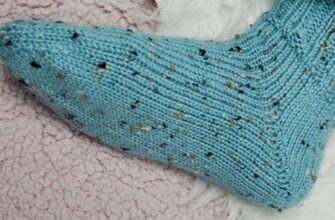
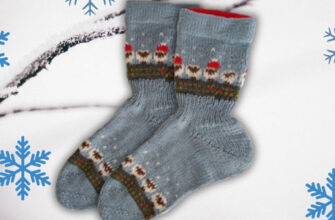
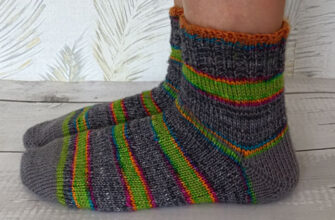
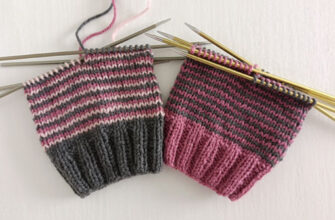
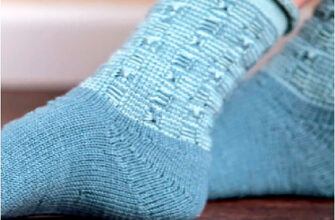
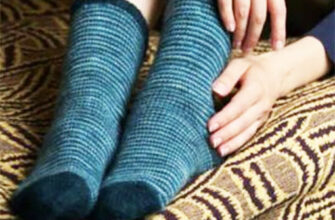
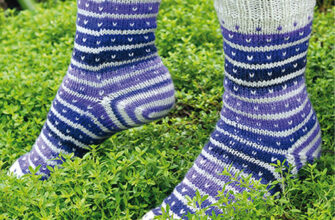
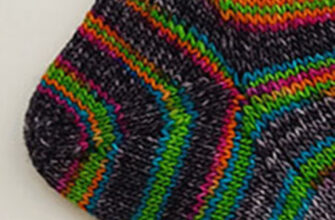
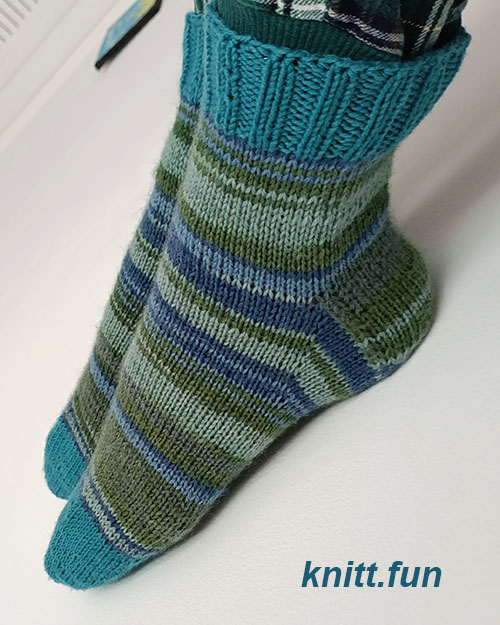
These women’s toe-up socks with a heart-shaped heel are knitted from leftover yarn. This knitting method is especially convenient when there is not enough yarn of a single type for the entire project. The socks are knitted in the round using five double-pointed needles.
The toe is shaped by evenly increasing stitches. The instep gusset is formed by increasing stitches on both sides along the edges of the sole. The heel cup is shaped with short turning rows.
The heel flap is worked in rows back and forth. While knitting the flap, the gusset stitches are joined to the heel by knitting together the edge stitches of the heel and the gusset in both knit and purl rows.
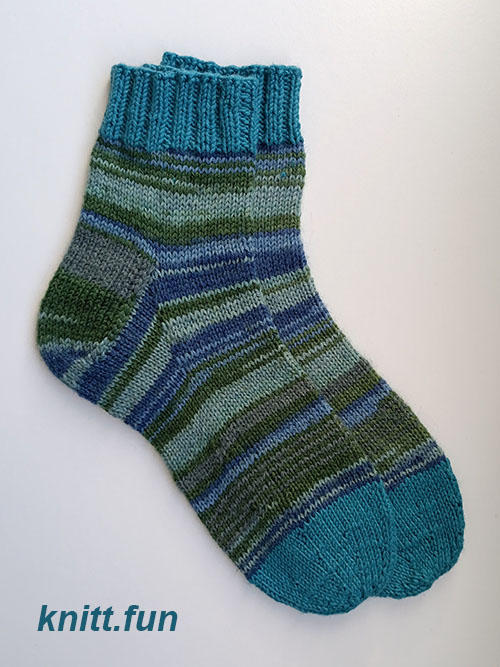
Materials, tools and knitting techniques
Sizes
36–37; 38–39; 40–41.
Tools and Materials
- Any 6-ply sock yarn with the following parameters: 100 g / 250 m (273 yd): 55 g – main color, 30 g –contrasting color.
- Double-pointed needles 3 mm = 11 UK.
- Stitch markers.
- Tapestry needle for sewing.
Stitches and Techniques
- Stockinette stitch.
- Ribbing: 2×2 (k2, p2).
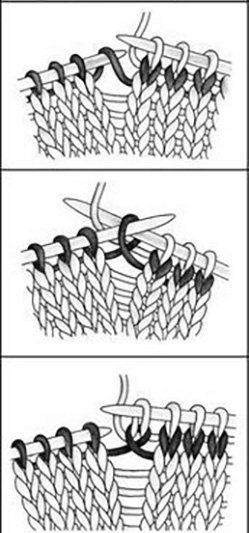
- Increase 1 stitch from the strand between stitches with a left-leaning increase.
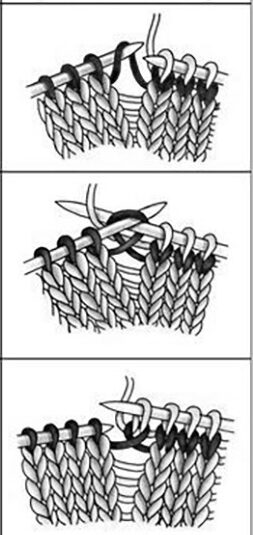
- Increase 1 stitch from the strand between stitches with a right-leaning increase.
- K2tog with a left lean.
- P2tog.
- Double stitches in knit and purl rows.
Gauge
22 sts × 30 rows = 10 × 10 cm = 4// х 4//.
Cast-On and Toe
Using the contrasting yarn, cast on 4 stitches on each of two needles using the Judy Becker method, for a total of 8 stitches. Knit one row.
Distribute the stitches onto 4 double-pointed needles, 2 stitches on each needle. Place a marker to indicate the beginning of the round. Continue knitting in the round.
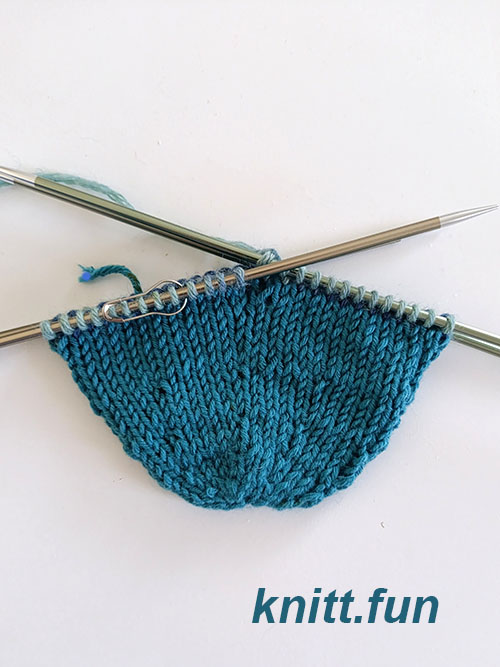
Row 1: increase 1 stitch from the strand between stitches with a right lean, k1 — repeat from * 8 times
Row 2: k16
Row 3: increase 1 stitch from the strand between stitches with a right lean, k2 — repeat from * 8 times
Rows 4–5: k24
Row 6: increase 1 stitch from the strand between stitches with a right lean, k3 — repeat from * 8 times
Rows 7–9: k32
Row 10: increase 1 stitch from the strand between stitches with a right lean, k4 — repeat from * 8 times
Rows 11–14: k40
Row 15: increase 1 stitch from the strand between stitches with a right lean, k5 — repeat from * 8 times
Row 16: k48
Only for size 40–41
Row 17: increase 1 stitch from the strand between stitches with a right lean, k12 — repeat from * 4 timesRow 18: k52
Foot and Instep Gusset
Using the main color yarn, knit in the round in stockinette stitch until the length of the sock from the cast-on edge reaches:
14; 15.5; 16.5 cm = 5.5 //; 6 //; 6.5 //.
Now begin increasing stitches to form the instep gusset.
The beginning of the round is located in the center of the heel, between needles 1 and 4.
Row 1: Knit all stitches on needle 1; before the last stitch increase 1 stitch with a left-leaning increase.
Knit stitches on needles 2 and 3.
On needle 4: knit 1 stitch, increase 1 stitch with a right-leaning increase, then knit to the end of the needle.
Row 2: Knit all stitches.
Repeat rows 1–2 until 8 stitches have been added on each side.
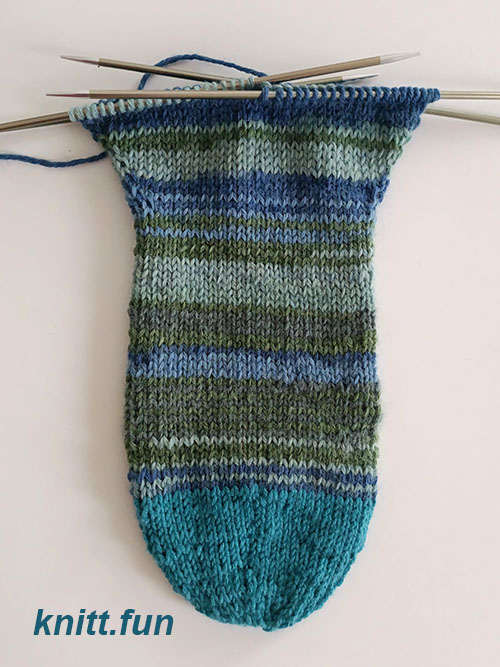
As a result, there should be: 64; 64; 68 stitches total.
On needles 1 and 4: 20; 20; 21 stitches.
On needles 2 and 3 (unchanged):12; 12; 13 stitches.
Heel Cup – socks with a heart-shaped heel
Place the stitches of the front part of the sock on a stitch holder.
Redistribute the back stitches of the sock onto four needles.
The outer needles (left and right) should contain the original number of stitches before forming the gusset: 12; 12; 13 stitches.
The middle needles should contain the stitches added during the gusset shaping: 8 stitches each.
The heel cup is worked on the middle 16 stitches using short rows with increases.
Knitting begins in the middle of a knit row using the needle that holds the second half of the middle stitches.
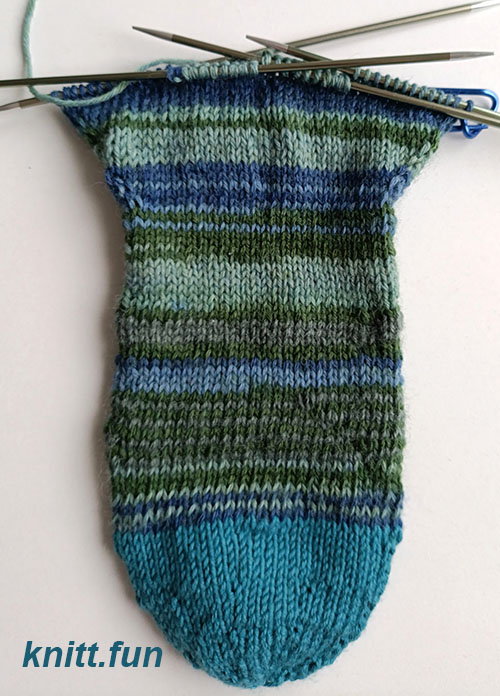
Row 1 (½ knit row): Knit until one stitch before the end of the row, increase 1 knit stitch from the strand between stitches, knit 1 stitch, turn.
Row 2 (purl row): Make 1 double stitch, p1, place a marker, purl to the end of the middle needle.
One stitch before the end increase 1 purl stitch from the strand, p1, turn.
Row 3: Make 1 double stitch, k1, place a marker, knit to one stitch before the marker, increase 1 stitch from the strand, k1, turn.
Row 4: Make 1 double stitch, p1, place a marker, purl to one stitch before the marker, increase 1 purl stitch from the strand, p1, turn.
Continue in this manner until 8 stitches remain in the center — 4 stitches on each needle.
Finish the heel cup in the middle of a purl row.
Each needle should contain:
- four pairs of an increased stitch and a double stitch (marked)
- four knit stitches
Total: 12 stitches per needle.
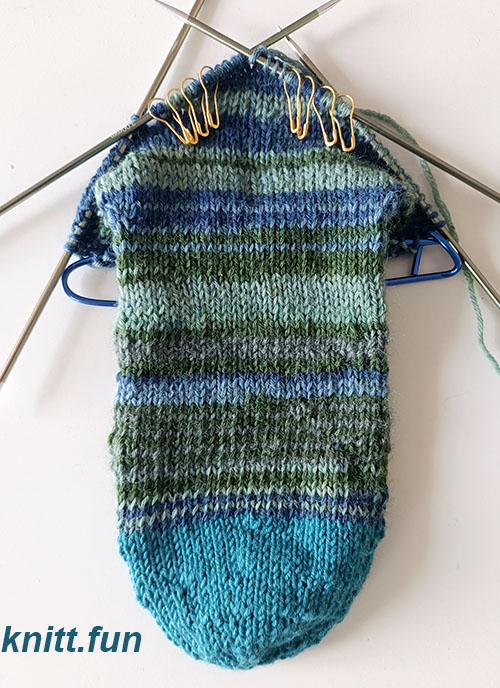
Heel Flap
Socks with a heart-shaped heel, where the heel flap is worked across all stitches of the back part of the sock.
Work begins from the middle of the heel.
Double stitches are knitted as one stitch, working both strands together.
Row 1 (½ knit row): Knit all stitches. Knit double stitches through both strands. Knit the last heel stitch and the first gusset stitch together with a left-leaning decrease, turn.
Row 2 (purl row): Slip 1 stitch. Purl all stitches, working double stitches through both strands. Purl the last heel stitch and the first gusset stitch together, turn.
Row 3: Slip 1 stitch, knit all stitches. Knit the last heel stitch and the first gusset stitch together with a left-leaning decrease, turn.
Row 4: Slip 1 stitch, purl all stitches. Purl the last heel stitch and the first gusset stitch together, turn.
Repeat rows 3–4 until the original number of stitches remains on the needles:
12; 12; 13.
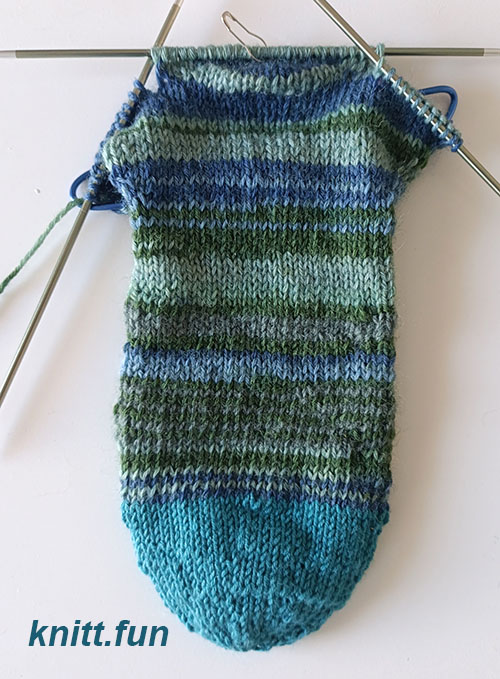
Leg and Ribbing
The leg is knitted in the round to the desired length or until the main yarn runs out.Then knit ribbing (k2, p2) for 4–5 cm = 1.5–2 //, and bind off stitches using any preferred method.
Conclusion
In this article, we showed how to knit women’s toe-up socks with a heart-shaped heel using leftover yarn. We hope that this detailed description will help you knit comfortable and warm socks for yourself and your loved ones.