The Japanese short rows method is considered one of the most advanced techniques for working short rows. For this reason, it is most commonly used in garment knitting, particularly for shaping shoulders and necklines. It is rarely used for knitting a boomerang heel.
Creating the Turning Points
Work in pattern to the turning point, then turn your work. Place a marker on the working yarn (Photo 1).
Slip the first stitch and continue working in pattern to the next turning point. Place another marker on the yarn and turn the work again (Photo 2).
Slip the first stitch without knitting it and continue working in pattern to the first turning point.
Working the Turning Points
On a Right-Side Row
Work the row in pattern to the turning point. Knit the turning stitch.
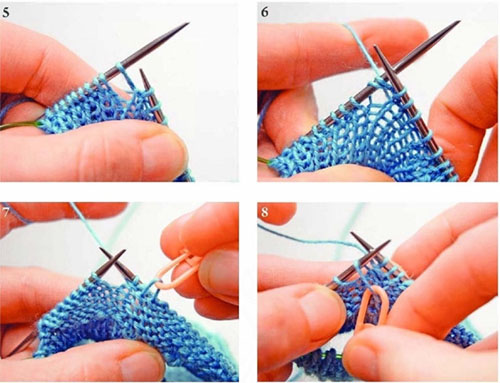
Take the marker that was placed on the yarn at the turn, pull up the strand, and place it onto the left needle as if it were a knit stitch (Photos 3, 4).
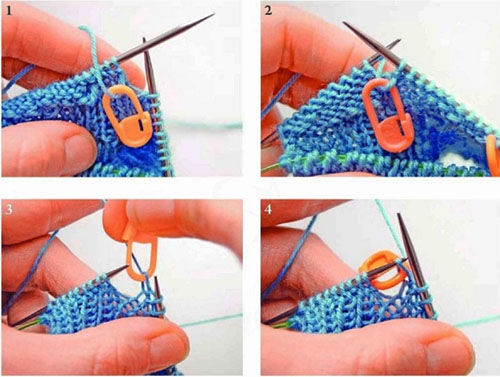
Remove the marker and knit the lifted strand together with the next stitch on the left needle using a right-leaning decrease (Photos 5, 6).
On a Wrong-Side Row
Work the row in pattern to the turning point. Purl the turning stitch.
Slip the next stitch from the left needle to the right needle without knitting it.
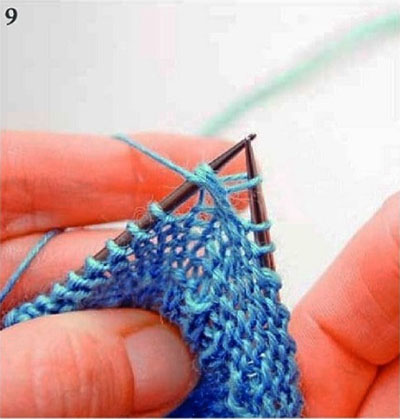
Take the marker that was placed on the yarn at the turn, pull up the strand, and place it onto the left needle as if it were a knit stitch (Photos 7, 8).
Return the slipped stitch from the right needle to the left needle and purl it together with the lifted strand as a single right-leaning purl decrease (Photo 9).
The article describes the Japanese method of knitting short rows. Read our other articles: